
As responsible business conduct becomes enshrined in new laws, one requirement keeps cropping up: companies must carry out meaningful stakeholder engagement (MSE). But what does that mean in practice?
STITCH partners had been actively advocating for strong human rights due diligence (HRDD) legislation. But through this process, they found that while standards like the UNGPs, OECD Guidelines and ILO instruments provide a foundation for MSE, they don’t give concrete direction on how to actually implement it. This leaves room for companies to treat engagement as a formality, and risks burdening workers and communities without real benefits.
To address this gap, STITCH members developed a practical, cross-sectoral framework that defines and operationalises meaningful stakeholder engagement.
Story of Change
How STITCH developed the Framework and Guidance on Meaningful Stakeholder Engagement
“A lot of ‘lingo’ is used around multi-stakeholder engagement, but when you look closely, nothing really tells you how to do it meaningfully.”
– Quirine Lengkeek, Policy Advisor Lobby and Advocacy at Mondiaal FNV
What is the MSE Framework?
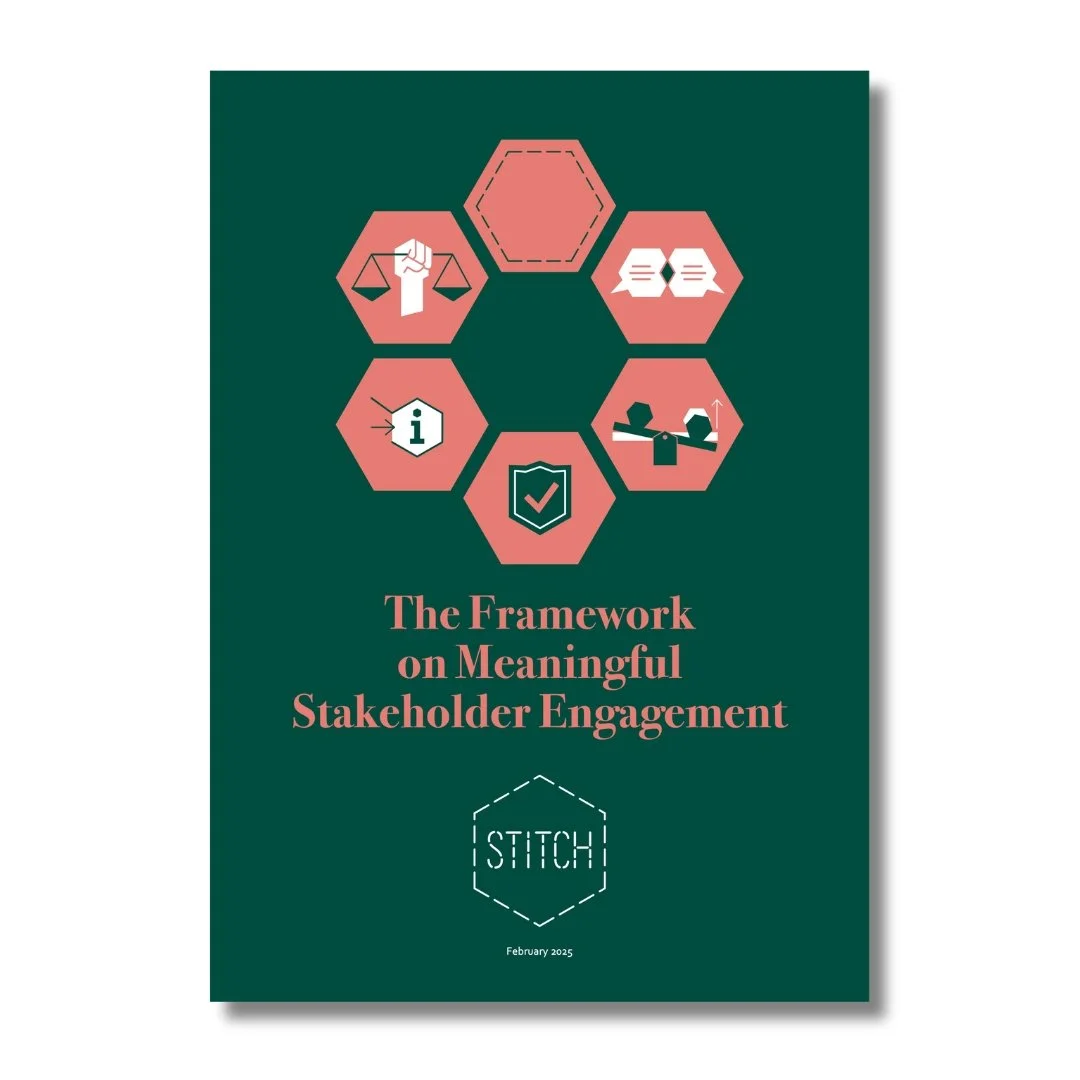
The MSE Framework is a global reference for companies on how to embed meaningful engagement into their due diligence, as well as how rights-holders, governments, and other stakeholders can participate in the process.
Drawing from international standards, including the UNGPs, OECD Due Diligence Guidance, and the ILO MNE Declaration, it unpacks five core principles: Legitimacy, Accessibility, Safety, Equitability, and Respect. Learn more about the MSE Framework.
Some STITCH members had already capitalised on these same consortium strengths when developing the Common Framework for Responsible Purchasing Practices (RPP) as a joint effort together with external stakeholders. That process demonstrated that the industry credited them with the necessary expertise and relevance to set internationally recognised standards, since the CFRPP was widely picked up.
Recognising the industry’s shift from voluntary to mandatory standards, STITCH partners decided to take the lead in creating practical guidance on stakeholder engagement.
Defining key terms
Bringing together such a diverse group meant not everything would align easily. A member of the consortium recalls: “We needed to understand how different actors within STITCH, and the stakeholders they represent, approach social change. It was a process of push and pull between partners, where we all needed to give and take to arrive somewhere.”
To manage this, the MSE Working Group, with representatives from each STITCH member, rolled out a staged process: mapping internal and external interpretations of MSE, organising a deep-dive workshop in Bangkok, and consulting external experts to align with legal and industry expectations.
One of the most useful steps was mapping STITCH partners’ experiences before the Bangkok workshop. The perspectives of workers and brands were represented by STITCH partners — the unions and MSIs. To include a supplier perspective, the Secretary General of the Confederation of Indian Textile Industry (CITI), a national business association, was invited to join the discussions. Two other external participants in the workshop were the Awaj Foundation, a labour rights NGO from Bangladesh, and the Cambodian Labour Confederation.
Discussions in Bangkok allowed for honest, sometimes difficult conversations on who is a rights-holder, what makes engagement ‘meaningful’, and what success looks like.
Eventually, the consortium came to an agreement on a definition of what MSE is and should be. Rather than trying to capture the complexity of MSE in a single statement, the partners defined each of the three concepts individually — ‘meaningful’, ‘stakeholder’, ‘engagement’ — to provide greater nuance and leave less room for individual interpretation.
STITCH as a real-world example of MSE
At the STITCH Mid-Term Conference in Hanoi, partners saw their own setup — a consortium of trade unions, CSOs, and MSIs from both production and market countries — as a model of MSE in action.

From principle to practice
Once definitions were clear, the real challenge began: making the principles actionable. The five principles — Legitimacy, Accessibility, Safety, Equitability, and Respect — were inspired by existing standards. But turning them into practical steps required a deeper dive.
In Bangkok, the group debated what each principle meant in context: What does accessibility mean for a migrant garment worker? How do you ensure safety when workers fear retaliation?
The discussions were intense, but necessary. They helped shape the framework’s depth and relevance, ensuring that it’s not just a list of principles, but a guide rooted in reality. One thing that all partners agreed on from the start is that engagement should not be a mere formality, but rather a dynamic, ongoing process that delivers tangible results and fosters trust, particularly with rights-holders.
STITCH enabled the partners involved in the process to bring together diverse industry perspectives, to negotiate and eventually align these perspectives to create a single, industry-wide framework, as well as to call on external legal expertise to ensure it matches international legal requirements. The MSE Framework was launched in February 2025.
A new tool for unions: MSE Framework in the MENA region
Ahmed Kamel, Regional Secretary for the MENA region at IndustriALL, immediately saw the potential. After learning about the MSE Framework, IndustriALL’s MENA office invited STITCH partner Mondiaal FNV to present it to their business counterparts.
“Employers frequently ask us questions about meaningful stakeholder engagement, why it is important, what it really entails, and what expectations are set in the new HRDD legislations on it,” says Kamel. “Having everything in one document, updated and ‘fashionable’ as it is related to the current discussion, is important if we wish to engage companies at all supply chain levels.”
IndustriALL already had its own approaches, but the Framework added something new. “The framework really lays the foundation for our discussions with employers in a clear way and helps us to develop better arguments.”
What stood out most to Kamel was the Framework’s recognition of global unions: “Often, at national level, employers are unaware of the existence of global unions. So referencing to our work in this framework increases the awareness of the valuable role we can play.”
Looking ahead, Kamel is keen to see the Framework translated into regional languages to broaden its uptake: “In a year or so, I am curious to see how much we have progressed by using the Framework.”
From Framework to Practice: Technical Guidance and Early Application
To ensure the MSE Framework could be applied in real-world settings, STITCH partners developed a Technical Guidance tailored to the garment, apparel and textile sectors. Supported by STITCH funding, this document turns the principles into practical steps and was presented at the UN RBHR Forum in Bangkok in 2025. As Chakravarthi puts it, the aim was to “nudge businesses towards achieving outcomes rather than merely aligning with principles.”
The Guidance, developed from April 2025 onwards, became a 115-page roadmap structured around the six steps of an HRDD process. It explains who to engage, how to do so, and which principles apply at each stage. All six organisations contributed through consultations in Bangladesh, the MENA region, Cambodia, Vietnam, and workshops with brands.
To make the Guidance truly practical, STITCH partners included case examples, best practices, and new tools such as a leverage assessment and a legitimacy checklist. The final document was widely welcomed by brands and stakeholders, who expect it to help harmonise company approaches across the garment sector.
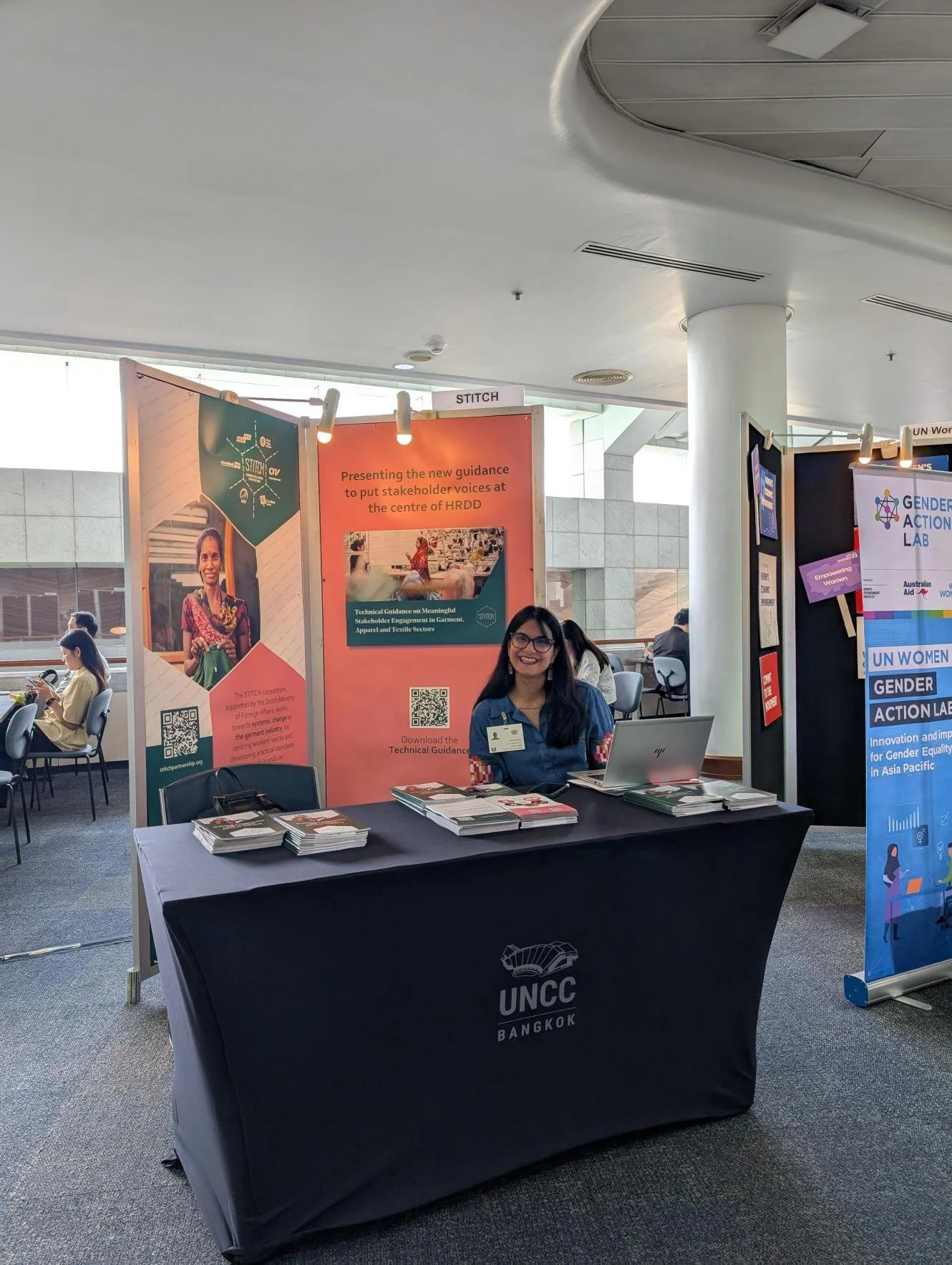
STITCH booth at the UN RBHR Forum 2025 in Bangkok
The Guidance is also shaping future work within the MSIs. Fair Wear has made MSE one of its central organisational pillars, and the Ethical Trading Initiative (ETI) will integrate MSE into its HRDD framework andwill continue to deliver initiatives and training sessions on MSE in 2026. ETI and Oxfam are now exploring use of the Framework in sectors beyond garments, an early sign of its broader relevance.